

 I remember standing in my empty spare room three years ago, scrolling through fitness equipment websites at 11 PM, completely paralyzed by choice. Should I get dumbbells or kettlebells first?
Did I really need a bench?
Would resistance bands actually do anything, or were they just glorified rubber? I had $500 burning a hole in my pocket and absolutely zero idea what would actually get me results versus what would become an expensive coat rack.
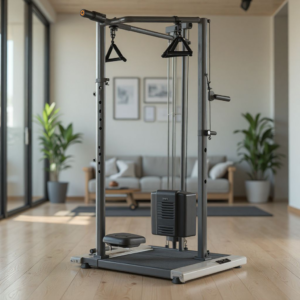
Here’s what nobody tells you upfront: the equipment that works isn’t necessarily the equipment everyone talks about. The stuff gathering dust in garages across America usually consists of “complete home gym systems” that promised everything but delivered mostly guilt and storage headaches.
Your brain wants to solve the fitness problem by buying things. It feels productive.
It feels like progress.
But I’ve watched friends drop $3,000 on elaborate setups they used twice, while I’ve seen others transform their bodies with three pieces of equipment that cost less than a decent dinner out. The difference wasn’t the gear, understanding what actually matters when you’re just starting out made all the difference.
The Real Starting Line
Most beginners approach home equipment backwards. They ask “what do I need?” when they should be asking “what will I actually use?” These are wildly different questions with wildly different answers.
The functional least for legitimate strength training at home comes down to progressive resistance that you can apply to compound movements. Everything else is optimization, convenience, or frankly, distraction.
You need something heavy that can get heavier over time, and you need enough space to move through basic human movement patterns: pushing, pulling, squatting, hinging, and core stabilization. That’s the whole foundation right there.
Adjustable dumbbells solve about 80% of what beginners need in a single purchase. A quality pair ranging from 5kg to 20kg covers your first year of training without requiring an entire room dedicated to fixed-weight sets.
The mechanism matters less than the adjustability itself.
Whether it’s spin-lock collars, dial systems, or pin-selection doesn’t really matter when you’re learning to properly perform a goblet squat or learning what a properly engaged shoulder blade feels like during a row.
I started with 5lb, 8lb, and 10lb fixed dumbbells because that’s what fit my actual budget. For three months, that was enough.
I wasn’t trying to impress anyone, and my muscles didn’t know the difference between expensive equipment and basic weights.
They only knew tension, time under load, and progressive challenge.
The psychology of starting lighter than you think you need pays dividends six weeks later when you’re still training consistently instead of nursing a lower back injury from ego lifting with equipment you couldn’t control properly. Your nervous system needs time to learn movement patterns before you pile on heavy loads.
Starting with weights that feel almost embarrassingly light allows your brain to wire proper motor patterns without the interference of compensation strategies that heavy weights force.
The Kettlebell Question
Kettlebells occupy this really interesting space that most beginners don’t understand. They’re not just round dumbbells, the weight distribution fundamentally changes how exercises feel and what adaptations they create.
The center of mass sits about six inches away from your grip point, which means every movement needs more stabilization than the equivalent dumbbell exercise.
What makes kettlebells genuinely different is how they excel at ballistic movements. Kettlebell swings, for instance, build strength, cardiovascular capacity, and posterior chain power simultaneously in ways that dumbbells simply can’t copy.
A single 16kg kettlebell can deliver a completely legitimate full-body workout that rivals equipment collections costing twenty times more.
But here’s the thing nobody mentions: kettlebells have a learning curve. The movements that make them special, swings, snatches, Turkish get-ups, require technical proficiency that beginners don’t have yet.
Starting with kettlebells before mastering basic movement patterns is like learning to drift race before you can parallel park.
Technically possible, but probably not optimal.
For most beginners, a single moderately-heavy kettlebell (12-16kg for most people) makes sense as a second or third equipment purchase, not the first. Use it primarily for goblet squats, which teach proper squat mechanics better than almost any other tool, and for basic swings once you’ve developed enough hip hinge competency to avoid lower back compensation.
The goblet squat position, holding a weight at chest height, automatically creates better posture and depth than bodyweight squats ever do. Your torso stays more upright, your core engages harder to counterbalance the front-loaded weight, and you naturally sink deeper because the counterbalance helps you maintain your center of gravity.
This makes kettlebells incredibly valuable for teaching proper squatting mechanics, even if you’re not ready for advanced kettlebell-specific movements yet.
The Resistance Band Reality
I really underestimated bands for the first six months of my home training. They seemed like the equipment version of participation trophies, something to make you feel like you’re working out without actually providing real stimulus.
I was completely wrong.
Quality resistance bands with varying tension levels provide progressive overload that’s genuinely comparable to free weights for beginners, with several distinct advantages. Joint stress is significantly lower because the resistance curve matches human strength curves better than fixed weights.
The eccentric (lowering) phase doesn’t create the same muscle damage that makes beginners too sore to train consistently.
And the space-to-functionality ratio is unmatched, a finish band set fits in a drawer.
Where bands really shine is in movement patterns that free weights handle awkwardly. Face pulls for rear deltoid and rotator cuff health, lateral raises for shoulder development, and banded good mornings for hip hinge patterning all work better with bands than dumbbells.
They’re also genuinely superior for warm-up and activation work, getting muscles firing properly before compound movements.
The psychological barrier with bands is real, though. They don’t feel substantial.
There’s no satisfying clank of metal or visible weight plates to mark progress.
This matters more than it should, because part of building a consistent training habit involves tangible feedback that you’re getting stronger. For some people, the lack of that concrete feedback undermines motivation in ways that lighter dumbbells somehow don’t.
That said, bands become indispensable once you understand their proper applications. The constant tension they provide throughout an entire range of motion creates a different training stimulus than free weights, where certain portions of movements have minimal load because of leverage and gravity.
Bands maintain tension everywhere, which means your muscles work harder at positions where free weights might give you a break.
The Bench Debate
A weight bench changes what’s possible with upper body training, but it’s not strictly necessary for the first three to six months. You can perform pressing movements from the floor, you can do single-arm rows braced against a couch or sturdy chair, and you can work around the absence of a bench longer than most people realize.
That said, an adjustable bench multiplies exercise variety substantially. Incline pressing targets upper chest fibers that flat and decline angles miss.
Supported single-arm rows eliminate the core stability requirement that limits loading when you’re bent over unsupported. Hip thrusts become genuinely heavy when you can position your upper back against a stable surface at the right height.
The decision point comes down to space and commitment level. A folding bench that stores vertically or slides under a bed makes sense for people working in limited square footage.
But if you’re still in the phase where you’re not certain that home training will stick as a habit, adding a bench too early creates pressure and guilt when it sits unused.
I waited four months before adding a bench, and that timing felt right, I’d proven to myself that I’d use it before spending the money and dedicating the space. Those four months of floor presses and furniture-assisted rows didn’t limit my progress as much as I feared they would.
By the time I added the bench, I had enough body awareness and movement competency to really take advantage of what it offered.
Benches also enable exercises that are nearly impossible without them. Bulgarian split squats need rear foot elevation that’s difficult to copy without a bench or sturdy platform.
Seal rows require prone positioning that nothing else in your house can provide at the right height.
Step-ups work better with a stable platform at precise heights that furniture rarely matches.
Space-Efficient Cardio Solutions
Cardio equipment poses the biggest space challenge for home gyms. Treadmills, stationary bikes, and rowing machines deliver excellent cardiovascular training, but they’re large, expensive, and single-purpose.
For beginners still figuring out their training preferences, committing that much space and budget to cardio equipment is risky.
Jump ropes represent the most space-efficient cardio tool available. A decent speed rope costs $15-30, needs about six feet of clearance, and delivers high-intensity interval training stimulus comparable to running or cycling.
The learning curve is real, you’ll whip yourself in the shins repeatedly at first, but the return on investment is absurdly high.
The alternative approach involves making strength work more metabolically demanding through circuit training, reduced rest periods, and compound movement emphasis. A set of kettlebell swings performed for 30-second intervals with brief rest creates substantial cardiovascular demand without requiring dedicated cardio equipment.
This hybrid approach works surprisingly well for beginners whose primary goal is general fitness as opposed to sport-specific conditioning.
You can also structure dumbbell complexes that keep your heart rate elevated for extended periods. String together squats, presses, rows, and lunges without putting the weights down, and suddenly you’re doing cardio and strength work simultaneously.
Five exercises performed for 8-10 reps each without rest creates serious cardiovascular demand while building strength and muscle endurance.
Recovery Tools That Actually Matter
Foam rollers and mobility tools occupy the bottom tier of most beginners’ priority lists, which is backwards from how they should approach recovery. Your ability to train consistently matters infinitely more than your ability to train intensely, and recovery tools directly enable consistency by managing accumulated tension and maintaining movement quality.
A basic foam roller costs $25-40 and addresses muscular tension that accumulates from training and from sitting at desks for eight hours daily. Rolling tight hip flexors, IT bands, and thoracic spine before workouts prepares those areas for loaded movement.
Rolling the same areas after workouts helps manage the inflammatory response that creates excessive soreness.
The mechanism isn’t really about “breaking up adhesions” or “releasing fascia” despite what marketing materials claim. What foam rolling actually does is provide a novel sensory stimulus that temporarily reduces protective muscle tension through neurological mechanisms.
That reduction in tension allows better movement quality, which reduces compensation patterns, which reduces injury risk.
The effect is temporary, maybe 10-20 minutes, but that window is exactly when you need it for training.
Yoga blocks serve double duty as mobility tools and exercise modifiers. Elevating your hands during push-ups reduces the range of motion and resistance when you’re building toward full push-ups.
Placing blocks under your heels during squats allows deeper squatting for people with limited ankle mobility.
Using blocks to support your hips during stretching creates more sustainable positions for longer holds. These are really unglamorous tools that solve practical problems beginners actually face.
The Minimalist Setup That Actually Works
If I were starting over with current knowledge, here’s exactly what I’d buy first: one pair of adjustable dumbbells (5-20kg range minimum), one set of loop resistance bands (light, medium, heavy), one yoga mat with decent thickness (6mm minimum), and one basic foam roller. Total cost: roughly $200-250 depending on brands.
Total space requirement: about one corner of a bedroom or 60 square feet.
This combination enables every fundamental movement pattern. Squats, deadlift variations, pressing in multiple planes, rowing variations, core work, and mobility work all become accessible.
The limitations you hit with this setup are programming and knowledge limitations, not equipment limitations, for at least the first six months of consistent training.
After establishing genuine consistency, meaning you’ve trained three times weekly for 12+ consecutive weeks, then you add a folding weight bench (another $150-300). This addition unlocks better pressing variations and supported single-arm work, accelerating upper body development noticeably.
The third-phase addition, probably six months in, depends on your emerging preferences. If you love explosive training and metabolic work, add a kettlebell and maybe a plyo box.
If you’re gravitating toward serious strength development, add a barbell with bumper plates.
If bodyweight training is resonating, add a pull-up bar and maybe a suspension trainer. By this point, you’ll know what gaps you’re actually experiencing as opposed to guessing based on what equipment looks cool in Instagram videos.
What Most Beginners Get Wrong
The biggest mistake I see repeatedly is buying comprehensive equipment before establishing basic competency and consistency. Someone decides to get fit, spends $1,500 on a finish setup, and then faces analysis paralysis about which equipment to use for which purpose.
The friction of decision-making kills momentum before habits form.
The second mistake is starting too heavy. Ego and impatience convince beginners that if they can physically move a weight, they should train with that weight.
But proper form breaks down under loads that exceed your stability and control capacity, even if your prime movers can handle it.
Starting lighter than feels challenging allows neural adaptation, your brain learning movement patterns, without the interference of compensation patterns that heavy weights force.
Many beginners also neglect unilateral work entirely. Training one limb at a time reveals and addresses strength imbalances that bilateral movements mask.
Single-leg deadlifts, split squats, single-arm presses, and single-arm rows should comprise 30-40% of your training volume even as a beginner.
This requires adjusting equipment choices, you need dumbbells or kettlebells that allow asymmetrical loading, which barbells don’t provide.
The recovery neglect issue shows up around week four to six for most beginners. Training creates adaptations during recovery, not during the training itself, but beginners consistently underinvest in sleep, nutrition, and active recovery work.
No amount of equipment compensates for inadequate recovery, yet beginners keep buying more stuff instead of addressing the actual limiting factor.
People Also Asked
Can you build muscle with just dumbbells at home?
Yes, you can build significant muscle with just dumbbells at home. Dumbbells provide progressive resistance across all major movement patterns, squats, deadlifts, presses, and rows.
The key is consistently applying progressive overload by gradually increasing weight, reps, or sets over time.
Most beginners can make continuous progress with adjustable dumbbells for 12-18 months before needing extra equipment.
How much weight should a beginner start with for dumbbells?
Beginners should start with weights that allow 10-12 controlled repetitions with good form while leaving 2-3 reps in reserve. For most people, this means starting with 5-10kg dumbbells for compound movements like goblet squats and rows, and 2-5kg for isolation movements like lateral raises.
Starting lighter than you think you need allows proper technique development and reduces injury risk.
Are resistance bands as effective as weights?
Resistance bands provide comparable training stimulus to free weights for beginners, with some distinct advantages. Bands create constant tension throughout the entire range of motion and reduce joint stress compared to weights.
They’re particularly effective for shoulder and upper back development, activation work, and people with joint sensitivity.
However, tracking progressive overload is less precise with bands than with numbered weight plates.
Do I need a weight bench for home workouts?
You don’t need a weight bench for the first 3-6 months of home training. Floor presses, elevated push-ups, and furniture-assisted rows provide adequate upper body stimulus for beginners.
However, an adjustable bench significantly expands exercise variety once you’ve established consistent training habits.
Folding benches work well for space-constrained situations.
What is the best home gym equipment for small apartments?
The best equipment for small apartments includes adjustable dumbbells, resistance bands, a yoga mat, and a foam roller. This combination requires about 60 square feet of space, stores easily, and enables full-body training.
Adjustable dumbbells eliminate the space requirement of fixed-weight sets, and bands fold into drawers when not in use.
How do kettlebells differ from dumbbells?
Kettlebells have offset weight distribution with the center of mass about six inches from your grip point, requiring more stabilization than dumbbells. They excel at ballistic movements like swings and snatches that build explosive power and cardiovascular capacity simultaneously.
Dumbbells offer more versatility for traditional strength exercises and easier progressive overload tracking.
What cardio equipment works best for small spaces?
Jump ropes provide the most space-efficient cardio option, requiring only 6 feet of clearance and costing $15-30. They deliver high-intensity interval training comparable to running or cycling.
Alternatively, you can create cardiovascular demand through circuit-style strength training with minimal rest periods, eliminating the need for dedicated cardio equipment.
Key Takeaways:
Start with adjustable dumbbells, resistance bands, a yoga mat, and a foam roller, this $200-250 combination covers everything you actually need for the first six months of consistent training.
Equipment quality matters far less than consistency of use for beginners, so prioritize tools that reduce friction to starting workouts as opposed to optimizing for theoretical performance.
Add a weight bench after establishing genuine consistency (12+ weeks of regular training), then let your emerging training preferences guide subsequent equipment additions as opposed to following generic recommendations.
Visible, accessible equipment placement increases training consistency more than equipment quality or variety, so dedicate permanent space as opposed to constantly storing and retrieving equipment.
Most expensive home gym failures result from buying comprehensive equipment before establishing basic competency and consistency, start minimal, prove the habit, then expand strategically based on revealed preferences as opposed to anticipated needs.